Mom Criticises Australian Toy Company For Putting Exaggerated Lips And A Larger Nose On Black Baby Dolls
An Australian mum has ignited a massive online debate after calling out what she described as “exaggerated” facial features on a Black newborn doll she spotted in a toy store.
What started as a short video quickly spiralled into a heated discussion about representation, stereotypes, and who gets to decide what inclusivity actually looks like.
The woman shared the footage on TikTok, where it quickly went viral. Posting under the username @jeanchronicles, she filmed three baby dolls made by Miniland Dolls, a US-based company known for its focus on diversity and inclusion.
Miniland prides itself on producing “anatomically correct” dolls designed to represent “any race, gender or condition.” But the mum argued one of the dolls missed the mark.
In the video, filmed inside a toy shop, she added a caption that immediately caught people’s attention: “It’s the exaggerated nose, forehead and mouth for me.”
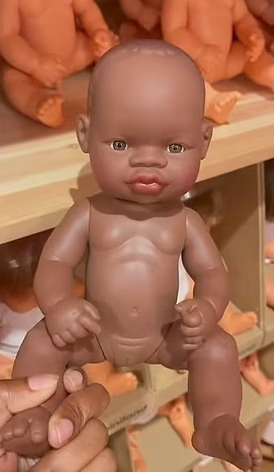
Her footage showed three dolls placed side by side. One was labelled “African,” with larger lips and a wider nose.
The other two, which she described as “white” and “brown,” had noticeably smaller and less pronounced facial features.
“These are adult features on a newborn”
The video spread fast, and so did the backlash.
As the comments rolled in, the woman clarified her stance in follow-up posts. She described herself as African and stressed she was not criticising Black features themselves.
“There is nothing WRONG with the features, but these are adult features on a newborn!” she wrote.
She questioned the logic behind the design, asking why only one doll appeared to have features she believed people “grow into” over time.
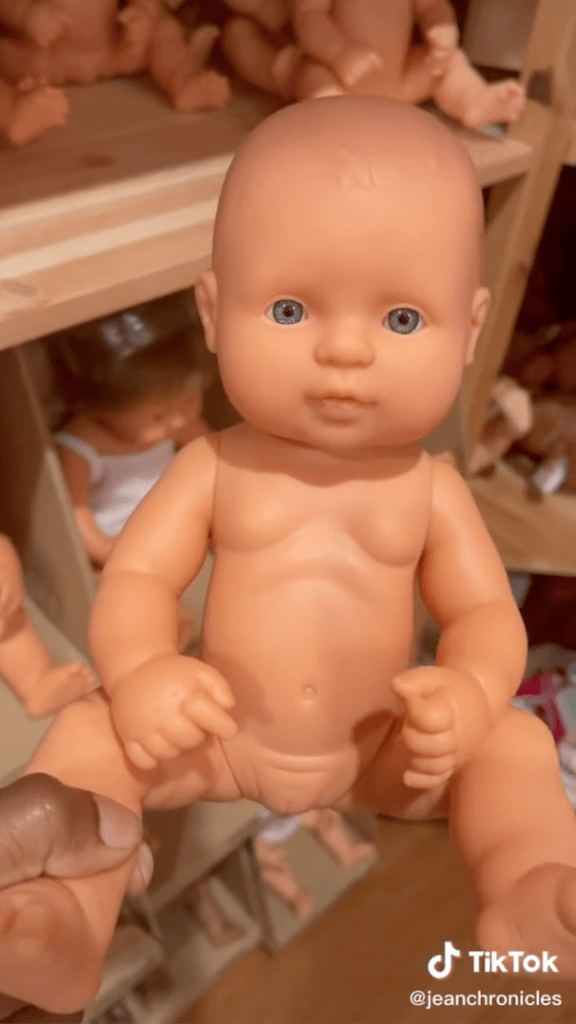
“If that was the intention, shouldn’t all the dolls have been made with features they grow into?” she asked.
She also raised concerns about who was involved in the design process. “The Black one is cute, sure y’all made them – and I’m sure no African had any input in this,” she wrote.
According to her, the doll reflected how Black people are perceived, not how Black newborns actually look.
“This is how YOU see US, not the reality of Black newborns!” she added.
The mum also pointed out smaller details that she felt were telling. She questioned why the white doll appeared to have a slight smile while the others did not.
“Notice how the white doll has a smirk/slight smile and the others don’t? Yeah no, that’s not a random coincidence!” she wrote.
She then challenged viewers directly. “If you’re Black and have a newborn that looks like this please show us, it will shoot this debate down real quick!”
“It’s about how we’re presented”
The woman made it clear she was not arguing for eurocentric designs. Instead, she said the issue was accuracy and age-appropriateness.
“Nobody said we want them to be eurocentric,” she wrote. “But that hairline, what genetic trait has our hairline starting halfway behind our forehead?”
She also stressed that she had no issue with dolls that reflect strong Black features in general.
“If you’re black and have these features, that’s beautiful,” she said. “I would gladly buy a Barbie with these features, but this is a newborn hence why it’s naked!
Responding to criticism that Black people should simply be grateful for representation, she pushed back hard.
“For those saying we shouldn’t complain and be grateful we are represented, well these are African dolls and I’m African,” she said.
The video divided viewers almost instantly. Many said they felt uncomfortable with what they were seeing.
Viewers react: ‘Uncomfortable’ vs ‘Amazing representation’
Some comments were blunt. “My jaw dropped when the video restarted,” one person wrote.
Another said: “I mean it’s sort of accurate for a teen or an adult to have these features but not proportional whatsoever for a baby.”
A third added: “I’m very uncomfortable with those dolls.”
Others echoed the mum’s observations about subtle differences. “And the white doll has a little smirk. The others don’t,” one commenter pointed out.

But not everyone agreed. Plenty of users defended the dolls and accused critics of overthinking it.
“What really bothers me is some of y’all be making fun of the first doll when in reality there are people who look like that. And they’re beautiful,” one person said.
Another wrote: “While I don’t necessarily agree with the Black dolls’ features, they still are a reality for some and I would buy it to show diversity.”
Others went further, saying they saw no issue at all. “That’s an amazing representation,” one user commented.
Another added: “I don’t really see the problem? my daughter actually had pretty similar features when she was born. At least they’re giving options.”
Some viewers also pointed out that Miniland’s range goes far beyond the three dolls shown in the video.
“I mean Minilands come in a lot more than these three,” one person said. “They have a lot of variety in face types and colours etc.”
Miniland responds to the backlash
As the debate grew, Miniland issued a statement defending its approach. A spokesperson told 7NEWS.com.au that the company works closely with communities when designing its dolls.
“At Miniland, we pride ourselves in respectfully representing various ethnicities, genders and conditions to encourage inclusivity in the hearts of children around the world,” the spokesperson said.
They added that the company aims to create dolls that reflect cultural heritage.
“Just as we’ve realistically created other ethnicities in our doll range, our African and African-American dolls are a direct representation of their communities’ spirit,” the statement read.
Miniland later released a much longer statement expanding on its mission. The company said its dolls are modelled on real children and that designers immerse themselves in different cultures before starting production.
They acknowledged that no two children look alike and said it was impossible to represent every individual experience. Instead, they aim to capture what they described as “the spirit of each ethnicity.”
Miniland also highlighted its work with Australian Aboriginal and Torres Strait Islander communities and its award-winning dolls representing children with Down syndrome and hearing implants.
A different option at Kmart
In a follow-up video, the mum shared a more positive experience after visiting Kmart Australia. She said she was impressed with the retailer’s Kindred Folk doll range.
“So I went to Kmart and found some really cute Black dolls,” she said.
“It’s not just about representation, it’s equally important HOW we are presented!”
That sentiment resonated with many viewers, with one commenter declaring: “Kmart for the win.”
As the debate continues, the video has become less about one doll and more about a bigger question.
When brands aim for inclusivity, who decides what feels authentic, and who gets to say when representation goes wrong?